Research note
A toy transit fit: what the trapezoid recovers on synthetic data
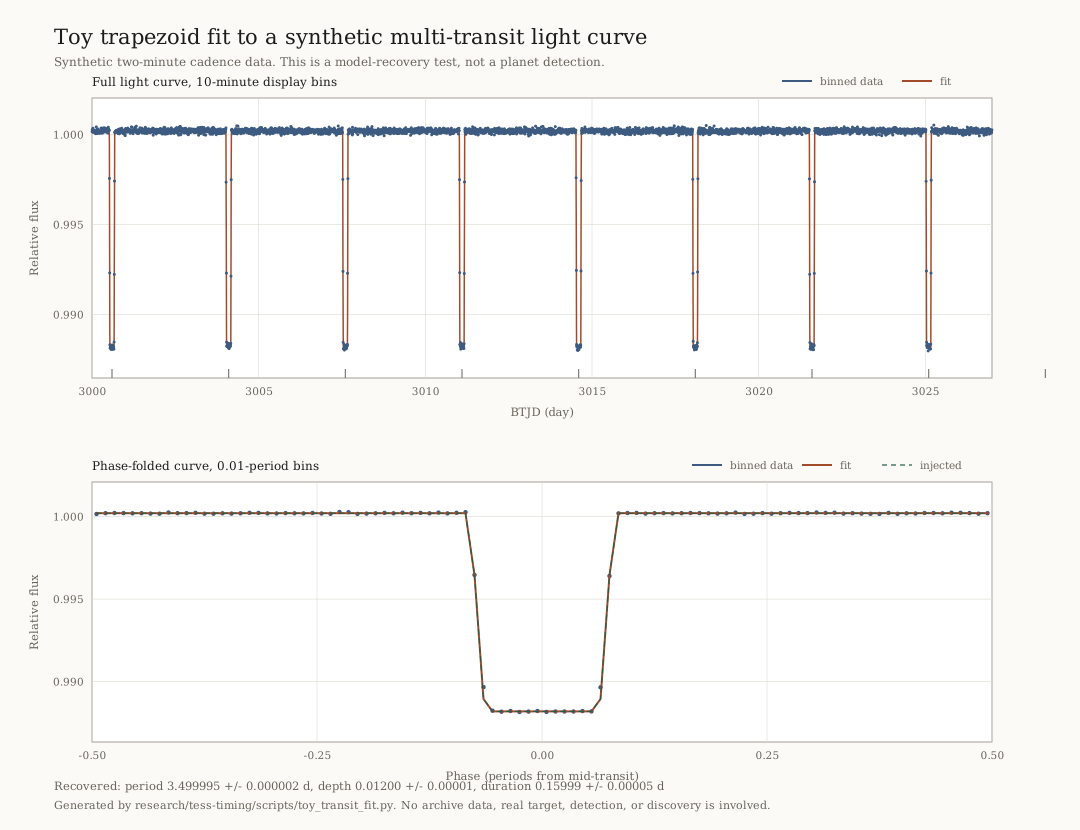
A seeded synthetic light curve fitted with a trapezoid model. The recovered parameters agree with the injected values within about two reported sigma.
This is a code-recovery check on synthetic data. The same trapezoid generated the light curve and fitted it, so agreement is expected. It is not evidence that the model is correct for a real transit and it is not a planet detection.
Synthetic input
The light curve was generated by toy_transit_fit.py with seed 20261022. It
covers 27.0 days at a 120 s cadence, which gives 19,441 cadences. The injected
model has a mid-transit time of 3000.6 BTJD, a period of 3.5 d, a depth of
0.012, a full duration of 0.16 d, a baseline offset of 2.0e-4, and white
Gaussian noise with a per-cadence sigma of 2.0e-4.
Model and fit
The model is a trapezoid in relative flux with a fixed ingress plus egress fraction of 0.2. It does not use a projected orbit, limb darkening, dilution, or the Mandel-Agol equations.
A box matched-filter search over periods from 1.0 to 8.0 d initializes a
scipy.optimize.least_squares fit. The fit frees five parameters: t0, period,
depth, duration, and baseline offset. The reported one-sigma uncertainties come
from the least-squares Jacobian, scaled by the reduced chi-square.
Result
The fit used 19,441 cadences, 920 of them in transit, with 19,436 degrees of freedom. The RMS is 199.60 ppm and the chi-square per degree of freedom is 0.9962. The optimizer converged.
| Parameter | Injected | Recovered | One-sigma | Difference / sigma |
|---|---|---|---|---|
t0 (BTJD) | 3000.6 | 3000.600030 | 0.0000366 | +1.48 |
| Period (d) | 3.5 | 3.499995 | 0.00000250 | -1.97 |
| Depth | 0.012 | 0.0119997 | 0.00000738 | -0.04 |
| Duration (d) | 0.16 | 0.1599928 | 0.0000455 | -0.16 |
| Baseline offset | 0.0002 | 0.00019933 | 0.00000147 | -0.46 |
Limits
- The noise is white and the stated uncertainty equals the injected sigma.
- The model is not physical. A trapezoid can bias depth and duration on real data with curved ingress, limb darkening, and a projected orbit.
- The period search only initializes the fit. It is not a detection statistic.
- The covariance ignores correlated noise, red noise, and dilution. Real TESS photometry has systematics that this fit does not model.
- A fit to a transit-like dip is not a planet detection.
Evidence in the repository
Topics: exoplanets, transit-timing, scientific-computing