Research note
Injection-recovery: what twelve synthetic transits can and cannot show
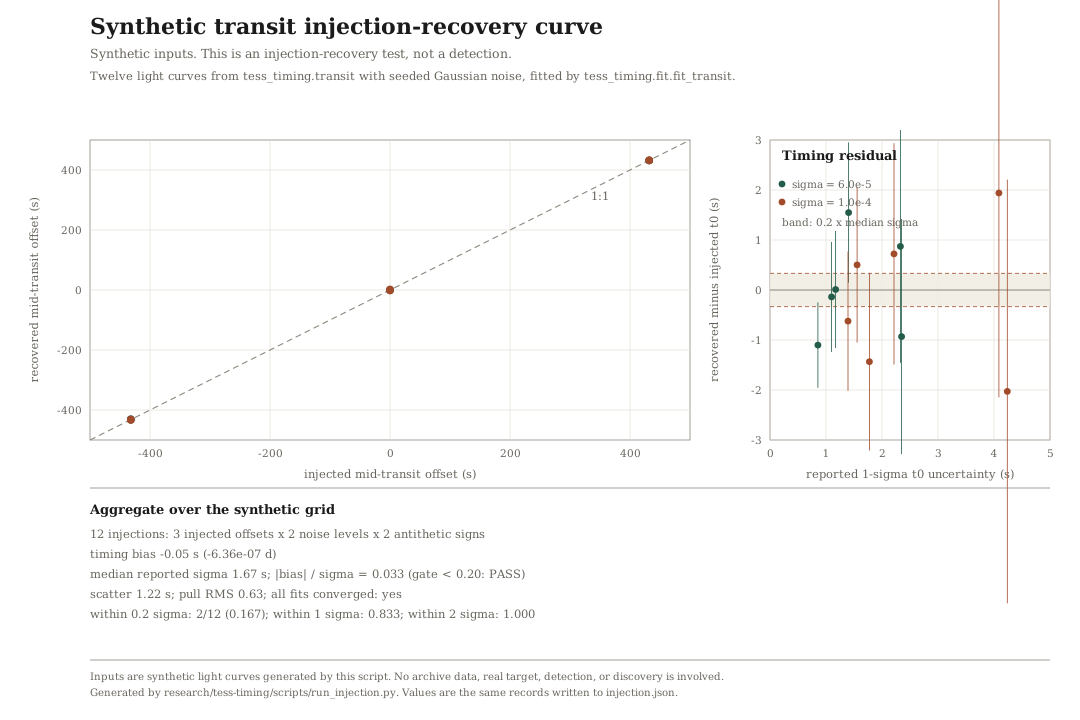
Twelve injected mid-transit times recovered on synthetic light curves. The timing bias is small against the pre-declared gate, but the sample is too small to calibrate a real pipeline.
The injection campaign asks whether the timing path recovers a mid-transit time that it was given. It does not test a real star and it does not measure a transit timing variation.
Method
Twelve synthetic light curves are generated from the committed transit model with seeded Gaussian noise, then fitted with the existing estimator. Each fit returns a mid-transit time and a one-sigma uncertainty. The campaign records the recovered minus injected time, the pull, and the aggregate bias.
The pass gate was declared before the run: the absolute aggregate bias divided
by the median reported t0 uncertainty must be at most 0.2.
Result
All 12 fits converged and all 12 mid-transit times were recovered.
| Quantity | Value |
|---|---|
| Injections | 12 |
| Aggregate bias | -0.055 s |
Median reported t0 uncertainty | 1.665 s |
| Absolute bias / median uncertainty | 0.033 |
| Scatter of recovered minus injected | 1.218 s |
| Scatter / median uncertainty | 0.732 |
| Pull mean | -0.078 |
| Pull RMS | 0.627 |
| Largest absolute pull | 1.288 |
| Within 1 sigma | 83.3 percent |
| Within 2 sigma | 100 percent |
| Gate threshold | 0.2 |
| Gate result | pass |
Limits
- Twelve injections are enough to catch a large bias, not enough to calibrate the tails of the uncertainty distribution.
- The noise is white and the model that generates each light curve is the model that fits it.
- There is no correlated noise, dilution, limb darkening, or transit timing variation in the injections.
- The result says nothing about a real TESS target or a real timing residual.
Evidence in the repository
Topics: transit-timing, astronomy-methods, reproducibility